Colourless Dreams (SA)


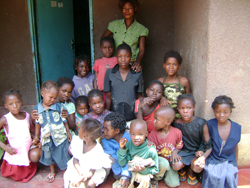
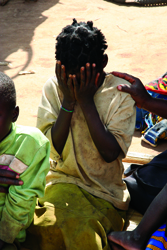
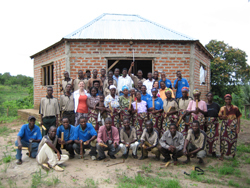
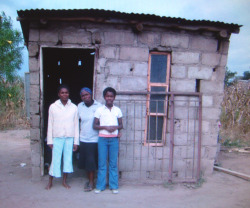
Jackie, 17, and her sister Laura, 11, live in a dilapidated one-room shack in the village of Welverdiend, within Bushbuckridge. Their mother died in 2006, leaving the girls in the care of their grandmother and father. In 2004 the girls suffered yet another loss at the death of their grandmother. To make matters worse, later that same year their father, their only provider, was involved in a road accident that left him paralyzed and permanently hospitalized.

Jackie and Laura face daily challenges, such as, hauling water from the community water tap which is two kilometers from their home and rationing the food they receive to make it last. They comfort one another as they spend each night alone and vulnerable in their rickety room.
The spirit of a champion (Zam)

Osborne Mwape is 11 years old and lives with his grandmother, Bana Kulu, in a community in Kabwe Zambia. His parents were HIV positive until they passed away in 2003. His mother died from Tuberculosis. She was not a believer but did give her life to the Lord on her death bed. The suffering and hardships Osborne endures are great. The hut that he and his granny share, burned down recently, and they had to use plastic and grass as a means of shelter during the cold and rainy winter season. Food is also scarce and Osborne sometimes misses school to look after the house while his grandmother goes out to look for a job or food.

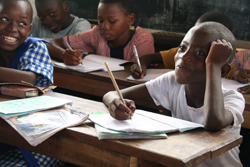
Hands at Work representative Floyd Mwila, a home based care manager in Kabwe oversees, New Life Christian community school which Osborne attends. The establishment of the school was partly due to a request by Osborne whose wish was to get some education to prepare him for the future. The school not only provides education but also helps to support and encourage Osborne, giving hope for his young dreams to be realized.

Osborne has the spirit of a champion; even at school, he is known as an encourager of the other young boys. His energy and willingness to participate, far surpasses his small size, be it in sport, school clean-up chores or any other school activities. Osborne is in grade 4 and is achieving good marks; he is positive and his little spirit is on fire!

Denial (Moz)

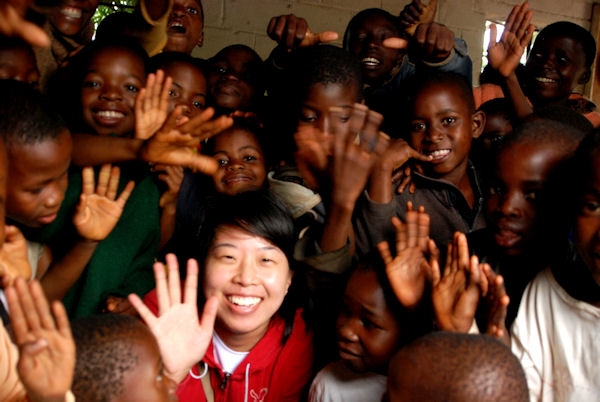
Hannah Chung from Welspring Church California, been volunteering with Hands at Work since August 2008, volunteering in Mozambique.

Last Friday was my first experience in encountering something so real but so… sad.

Tuesdays and Fridays, I go on home-based care in a community called Nhambia. The people in this community live relatively far from each other and grow their own maize in their mashambas (fields). If a bicycle or money to catch a shapa (local taxi) isn’t available, people must walk tens of kilometers to visit a market to obtain anything else.

A home-based care visit in Nhambia with a volunteer named Marcelino led us to the home of a thin and gaunt middle-aged lady. She greeted us, bringing us a mat to sit down on. She talked a little, but didn't say much; it was apparent that she was very sick. Every word was interrupted by what seemed like a chronic cough.

"Is she positive?" I asked.

“We don't know,” Marcelino said. “She didn't get tested.”

"Did you go to the hospital?" Marcelino asked her.

Breaking New Ground: Entering Malawi

Levy Mwenda is a nurse from Zambia who has worked with Hands for many years. Residing in South Africa, Levy has assumed many roles with Hands in several countries, including Mozambique, Democratic Republic of Congo, Zambia, and Nigeria.

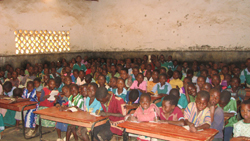
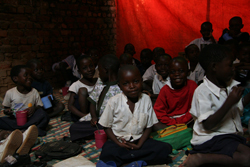
Levy’s first trip to Malawi is a ten-day undertaking to map out the community of Ngwele in Dedza. Knowing no one but a contact through a South African church, Levy goes to find out if this is a community in which Hands should work. Pastor Roy, the contact, is the headmaster of a school in Dedza. The two-room school holds 120 children in one room and 95 in the other, and Roy is the only teacher. He runs between the rooms throughout the day to teach both groups of children, who are packed tightly into the relatively small space. Roy has dreams of starting his own school, Levy discovers. Though the school he teaches in is extremely overcrowded, there are still many children who can’t afford the fees to attend. Roy wants to start a school that doesn’t require any fees and serves the most vulnerable children, those who have nothing.

Before doing anything else, Levy must receive clearance from the community leaders, including chiefs and tribal authorities. This step is important, as these leaders have the power to either enable or disable the work to begin. Levy seeks approval and partnership by sharing the heart of Hands at Work: to see the local church effectively caring for the dying, orphans and widows.

Driven to Care (SWZ)

The luxuries of paved roads and street lights have long been left behind by the time you reach the mountainside homestead of Samuel and Nomsa Lukhele, who head the Hands at Work community organization in Swaziland. The last leg of the journey into Kaphunga is treacherous, taken over roads so deeply weathered with grooves and ruts that you wonder each minute whether your vehicle will make it any further. The winds and twists of the road up the mountain are so frequent you are certain you will never find your way down. About twenty minutes into this body-jarring trek, you start to wonder if people could possibly live here at all; so remote, such a difficult trip, no other cars, no sign of civilization, how could people live here? Another half-an-hour and suddenly people are coming out of the dark night from all directions; women walking down the road, men offering to give directions, and lights peaking through trees are evidence of the living that is taking place here, where you would least expect it.

The next day we, a group of volunteers visiting Swaziland for the first time, drive to meet one of the home-based care’s oldest volunteers. Maria makes her way out to the road to greet us. She is 70, we later learn, but she doesn’t look it. She is strong and active. She proudly shows us the chickens she keeps for the orphans served by the home-based care and the wooden tool she uses to make mats out of river reeds and twine; painstakingly sewing each thin reed to another to form a mat for sitting and sleeping. The one she shows us has taken her three weeks to make. And she shows us the children.

Giving Back Hope (SA)

Ilary (left) and ConstanceA little mat with a nicely folded blanket packed in a corner, a comb, a half bottle of cooking oil, a few old jugs of water and a small table are all you’ll find inside this one-room house that provides shelter for four people.

Last year things were difficult for Constance, age 10, and her sister Ilary, age 14. Facing the death of their parents at a young age left them with a hole which no one could fill. Their grandmother took them in but had no way to support the two girls, so they left Mozambique, their home, in order to seek the help of distant relatives in one of South Africa’s poorest villages, Welverdiend, in Bushbuckridge area.

They found shelter with an uncle who owned a one-room house with his young wife and small child, but this was not enough space to house six people. The uncle was often away looking for work, but when he was home, the two girls and their grandmother had to find shelter at a neighbor’s house. This left the kids extremely vulnerable.

Watch Us Online!

Watch a TV program featuring Hands at Work in:

Living Truth, based in Toronto Canada, aired two programs in October 2008 highlighting Hands at Work in Africa’s work in Mozambique and South Africa.  The telethon raised sizeable funds to care for the vulnerable children of Africa by providing access to education, healthcare and food security through care centres.

Due to the success of the programs, Living Truth will return to Africa in May 2009 to film updates from the countries they originally covered, and also to highlight new areas in which Hands is working.The programs will air in Canada in October 2009.


Feeding Points in DRC

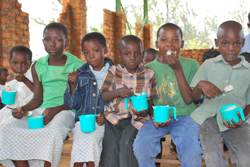
Hands at Work community organisations in DRC recently made the shift from food parcels for vulnerable children to feeding points. Feeding points are localized cooking points for children to attend daily to receive a hot, nutritious meal, rather than receiving monthly packages of food at home, where it is often misused or stolen from them. Feeding points provide a place for local volunteers to see the child getting the nutritious meal, and allow for daily checkups and more regular monitoring of the children’s health.

Focusing on Access to Education (NIG)

Despite an overwhelming need for access to education, enrolment at the Hands at Work community school in Lagos, Nigeria has been halted since October 2008 due to overcrowding.  The 182 primary school students overflowed the tiny wooden structure used as a school.   After a long search, the local home based care volunteers discovered land and negotiated an affordable deal to construct a new school, which will open in June 2009, enabling more vulnerable children to receive schooling.  

Ensuring Care in Zambia

Funding to care for 50 orphaned and vulnerable children by providing food security, access to education and healthcare for 14 months was received in March 2009 by Breakthrough Care Group, a community based organization operating in the Zambian village of Mulenga.  The money was raised by the members of Lakeview Free Methodist Church in Saskatoon, Saskatchewan, Canada.  

Hungry Season in Mozambique

Hungry season.  In Mozambique, food is scarce between October and April every year.  This year’s hungry season, October 2008 to April 2009, was particularly devastating.  Dry weather caused brush fires in September 2008, fires which burned numerous homes and crops, killing some and leaving many homeless and hungry. 

Late rain further exacerbated the problem.  People bought seed to grow maize in their mashambas (gardens) and planted them expecting rain to come at the normal time, usually in October or November, but it didn't.  The seeds died, and the people bought more seed.  Again, they planted them expecting rain to come, but it didn't

Waiting for Hope (SA)

In a one room house in Bushbuckridge, South Africa, three orphans wake themselves as the sun rises. They carefully fold their blanket and roll up their mat. Sleep is still on their faces. With no clothes to change into but the ones already on their backs, the two little boys, Clarence, 8, and Remember, 9, go outside. They sit in the sun amid chatting ladies and chickens. They wait.

Their sister Lorraine, 14, changes into her only other skirt, her school uniform, and carefully cleans herself for school. The boys use their fingers to write the alphabet in the dirt.

We Are Together

“We are together!”  This phrase rang constantly through the weeks of March 18th-29th, when Hands at Work in Africa hosted its 2009 Africa and International Conferences.  Representatives journeyed from seven of the African countries that Hands currently works in to gather together for their only annual meeting as a family.  Representatives from the international offices partnered with Hands and many other donors, church partners, friends and volunteers were also present.

 Because the entire Hands family can only gather together once a year, the conferences are an important time for the organization—to bring everyone up to speed on the inner and outer workings of Hands, to remind everyone of the standards and goals we are working for, but mostly to remind those who have devoted their lives to serving others in their African communities that they are not alone in their efforts.

Enduring Hardships at a Young Age (MOZ)

Maseo is ten years old. She lives with four siblings in Nhembia, Mozambique; the eldest is her sixteen-year-old brother. Maseo watched her parents die: her father in 2005 and her mother in 2006, after suffering long illnesses. This was too much for the young girl to handle and, shortly after their deaths, Maseo ran away from school and home to a neighboring town, selling sugar in the market.

Volunteers from Rubatano Home-Based Care, Hands at Work’s partner in Mozambique, had been helping the young children care for their sick parents. When the parents died, no relatives were available to live with the children, so they lived alone, and Rubatano’s home-based care volunteers watched over them. When Maseo ran away, the home-based care volunteers went to Beira to bring her home. The young girl, unable to cope with life without her parents, ran away a second time. Again the volunteers went to find her and this time she stayed in Nhembia.

A Chain of Giving (ZAM)

Fifty-two-year-old Lorraine began volunteering in the Shalom community organisation of Kabwe, Zambia in 2003. The divorced woman’s children were grown and moved out of her home when she became a volunteer and she showered all of her motherly love and care onto the patients and vulnerable children she dedicated herself to visiting.

In 2007, Lorraine became ill and tests revealed that she was HIV positive. This former volunteer of the home-based care suddenly became a patient, who with the help of her fellow volunteers began taking medication that would keep her alive. Today, Lorraine continues to battle her illness, but her active devotion as a volunteer has not ceased. Though unable to visit children and patients like she used to, Lorraine has taken two orphaned children into her own home to provide them a place to live safely and be cared for lovingly.

Lorraine’s story is one of a chain of giving: Lorraine receives as a patient of the HBC, but also continues to give, sewing into the lives of two young children.

When Hope Comes (ZIM)

In Mutare, Zimbabwe, there is much need for hope. But in a country where the money has become valueless and schools and hospitals are closing daily, it is hard to imagine an avenue by which hope might enter.

A partially blind sixty-five-year old grandmother stays in her one-room house in Sakubva, the poorest area in Mutare, with fourteen orphaned children. Most of these are the children of her five children who have passed away, unable to receive medical treatment in the ever-diminishing healthcare system. Though the children have found refuge and a roof over their heads with the grandmother, finding food is a daily battle

A New Level of Love and Devotion (DRC)

An orphaned child isn’t an easy child to care for. Extended family members seldom expect the challenges that accompany the arrival of such a child. When Grace’s parents died before she even began school, she and her twin brother were taken in by their aunt and uncle, who struggled to care for the children and needed support.

Esperance Home-Based Care sent local volunteers to help care for the children, inviting them to attend the free community school and providing them with a meal each day. Then 6-year-old Grace became a patient in the home-based care when she suffered a serious burn on her leg. For three weeks, the volunteers paid special attention to Grace to ensure that her injury was treated and healed properly. Her uncle and aunt, still struggling to know how to care for these new children, were overwhelmed by the commitment of the volunteers and the attention they paid to this one tiny girl.

Literacy School Expansion (NIG)

Construction of a literacy school to benefit vulnerable women and children began in Kano, Nigeria in early November. Since 2007 local volunteers in Kano have operated literacy training out of a two-classroom building, but the need has outgrown the current space, requiring the construction of a new facility.

Women from the rural agricultural community of Nariya in Kano marry young and know little of life other than working the land alongside their husbands. The volunteers host groups of these women for three month stints in the farming off-season, teaching them the foundations of reading and writing in their single-building facility. The ability to read and write is a skill set to which these women have never been exposed. It is a skill set that opens them up to the world in a myriad of ways and an ability that, to lack, is isolating.